













Historical Pisemka – Polish Letters from the Far East … – Uncle Wicek and his beloved Manżuria, 1918 – weekly LISTY POLSKIE Z DALEKIEGO EASTUR (POLISH LISTS FROM THE FAR EAST) weekly and monthly magazine ECHO GALEKIEGO EAST in Polish and Japanese

Hello,
we would like to share with others in the GA.PA Virtual National Gallery old magazines from Manchuria that were preserved in the house of our uncle Wincenty Skorka:
Please put our post in the gallery:
Uncle Wicek (Wincenty Skorka) and his Manżuria
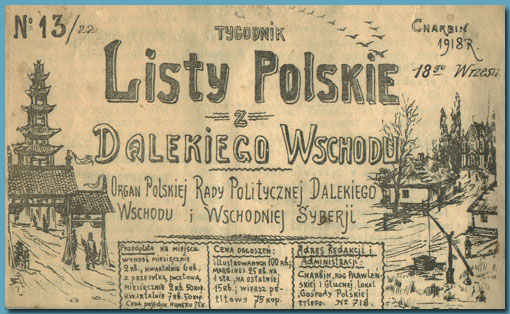
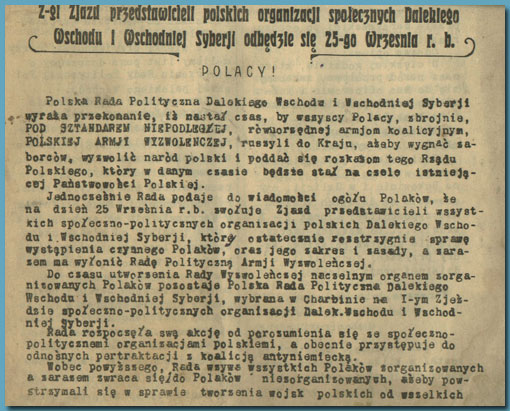
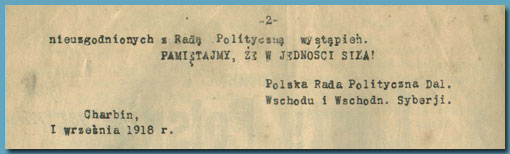
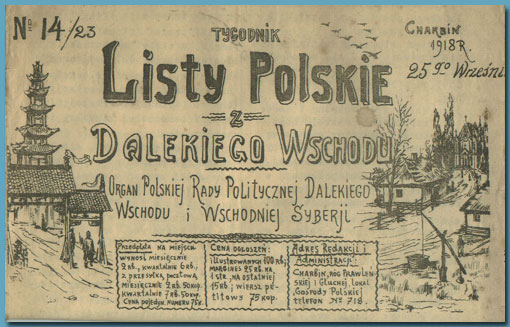
1. WEEKLY Polish Letters from the Far East, Organ of the Polish Council of the Far East and Eastern Siberia, Charbin (Harbin), the corner of Prawleńska and Głuche, Lokal “Gospody Polskiej”, No 13/22 of September 18, 1918 and No 14/23 of September 25, 1918
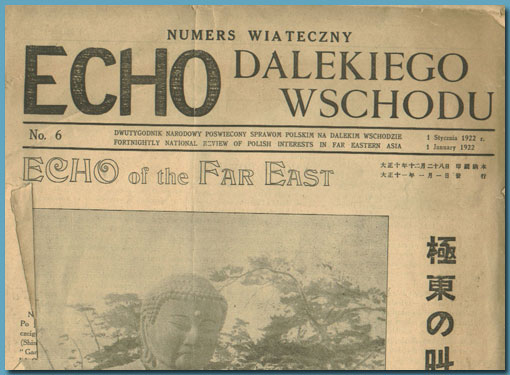
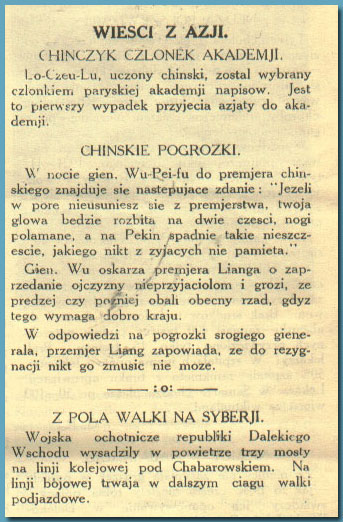
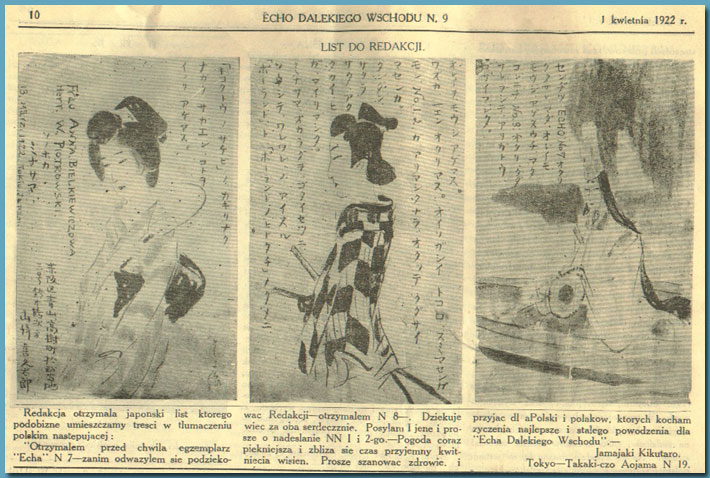
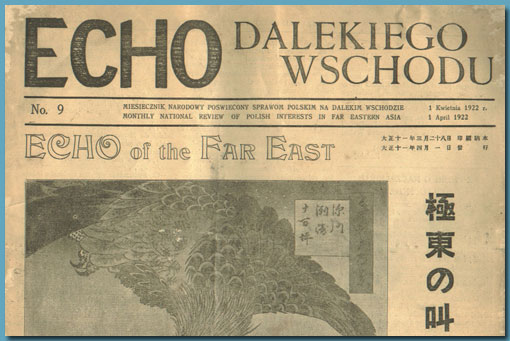
2. FAR EAST ECHO, National Monthly Magazine Dedicated to Polish Affairs in the Far East, Tokyo, Japan, No. 6 of 01/01/1922 and No. 9 of April 1, 1922.
Somehow these four magazines survived at home for so many years. Very interesting content, weekly printed lithographically in “Litografji Sztabu Redaktor Wł. Homan ”, the monthly is much richer in terms of illustrations, a lot of souvenirs from Poland and the former and current Japanese culture, printed in Polish and Japanese.
This family heirloom is after Uncle Wick, who fought and then lived in Manchuria (Russia’s war with Japan for territories in Asia – Korea, Manchuria 1904-1905), and then as a high-class engineer he built the Trans-Siberian Railway. After returning from Asia to Poland, he was fascinated with Buddhism, the culture of China, Mongolia and Japan until the end of his life. It must have been the amazing history of Poles in the 20th century, thrown by history to Manchuria and Japan, where, as citizens of Russia (Poland was then part of Russia), they had to fight for their national interests at all, and then, when they had to stay and live there, they created Manchuria and the Polish diaspora of Japan. They cultivated Polish culture in Manchuria, founded Polish associations and publishing houses. And after returning to Poland, conversely, with a huge heart and until the end of their lives, they cultivated the culture of Asia and Buddhism – the religion of the Far East in independent Poland.
To this day, the family memories have preserved the fragments of the past that after returning from Asia, Uncle Wicek traveled to Poland, to Italy near Warsaw, with a Chinese cook, which was a huge surprise for many friends. The people of Italy, just before the war, remembered him as a mustachioed old man, walking around Italy and dressed in the way of Chinese mandarin, they called him Chiang Kai-Shek.
Thank you for the opportunity to briefly mention Uncle Wick and his writings from Manchuria and Japan, and share this with others at the GA.PA National Gallery!
M.M.W.
CORRESPONDENCE:
7.
— Original Message —
Subject: ON THE GRANDPA FIGHTING IN THE MANDŻURSKA WAR
Date: Thu, 20 Sep 2012 19:47:11 +0200
From: Wiesława Proga
To:
Copy: Wiesława Proga
Dear Sir, I currently have the same problem as you seven years ago, unfortunately I do not have any starting point in finding the fate of my grandfather, maybe you now have any knowledge in what sources I could look for it (institutes? Archives? Internet addresses?) If so, then in which ones? I will be very grateful for any information.
Regards,
Grzegorz Proga
6.
—– Original Message —–
From: Romuald Oziewicz
To: dho@dho.com.pl
Sent: Friday, June 18, 2010 2:53 PM
Subject: Charbin , Mandżuria- POLONIA CHARBIŃSKA.
Good morning,
I came across this very interesting text. I was born in Charbin in 1950 and we left as one of the last Polish colonies in September 1952.
I live in Szczecin, where the Charbiński Club has been operating for over 20 years, the president is Dr. Leonard Spychalski .
We work closely with the Pomeranian Library in Szczecin (Mrs. Cecylia Judek).
We work closely with the Pomeranian Library in Szczecin (Mrs. Cecylia Judek). If you can ask for copies of these magazines, I would be very grateful.
Best regards and waiting for a reply.
Romuald Oziewicz
5.
—– Original Message —–
From: maria romanow
To: dho@dho.com.pl
Sent: Friday, October 19, 2007 6:43 PM
Subject: Information and Request …
Ladies and Gentlemen,
My name is Andrzej Romanow, I am prof. University of Szczecin, press historian and author of books in this field of science. For some time now, I have been collecting materials on the history of the Polish press in Harbin. I would be very grateful if you would like to provide me with xero of the attached numbers of “Polish Letters from the Far East” and “Echoes of the Far East”. Of course, I undertake to cover all related costs.
Please accept my regards
Andrzej Romanow
4.-
—– Original Message —–
From: Witold Stańczuk
To: dho@dho.com.pl
Sent: Wednesday, October 19, 2005 6:41 AM
Subject: Mandżuria 1905
Hello
Many thanks for posting at least some information from that period from Manchuria.
My family’s fate has also been linked to Manchuria. My Grandfather was drafted into the army and sent to Manchuria in 1904. Of course, he never returned from the Russian army – he stayed there. Our grandmother and her children also went to Manchuria, but they returned approx. year 1918.
We are currently completing family documentation from that period.
If you have information about Poles from the period 1904 – 1920, please send me a photocopy.
Thanks a lot.
3.-
From: Piotr Szczepaniak piotr.szczepaniak1 @ neostrada.pl
To: dho@dho.com.pl
Sent: Thursday, July 08, 2004 12:32 PM
Subject: Harbin
Hello,
I came across a page devoted to a brief mention of your Uncle Wick and the exhibits he brought from Harbin. I am a journalist, currently working on a film reportage project from China – one of the main topics will be the history of the Polish diaspora in Manchuria. I assume that in the film – apart from the photos from Harbin and statements of people who may still remember living with Poles in this distant corner of the world – there will also be statements of Harbinians who are still alive or their relatives who have some souvenirs, memories, notes or photos …
Please contact me for an exchange of views. I will be grateful for any help in documenting this interesting and little-known topic.
Regards
Piotr Szczepaniak
2. –
#GA.PA NATIONAL GALLERY
www.narodowa.pl
To: Maria Dybowska
Maria, we are happy to announce that we already have in our hands the two Weekly Polish LISTS FROM THE FAR EAST (Charbin, No. 13/22 of September 18, 1918 and No. 14/22 of September 25, 1918) and two Biweekly ECHO DALEKIEGO EAST (ECHO OF THE FAR EAST) (Tokyo, No. 6 of January 1, 1922 and No. 9 of April 1, 1922) issued simultaneously in Japanese.
We deliver the photocopies on Monday, April 5, 2004 in the morning – so we think that they will be ready for collection at noon on this spring day.
1. –
Sent: Thursday, April 01, 2004 10:40 AM
Subject: Re: Poland
From: GA.PA Gallery
Mrs. Maria,
Welcome and thank you for the mail.
Of course, all these souvenirs are ready to share with others – this is the principle of the GA.PA online gallery
Tomorrow we will try to xero these extraordinary weeklies from Siberia – where to deliver !? Or maybe someone will pick up at our office:
Dom Handlowy Oprogramowania
ul. Żeromskiego 4a lok. 13
01-861 Warszawa
time. 8.00 – 16.00 (but tomorrow after 10.00 because you have to take a xero)
Greetings, and we would like to inform you that these online galleries have something to do with our friends – also ethnographers – e.g. Wojtek Dąbrowski from Australia, Marek Bogatka from Australia (a traveler, he was also associated with the Asia and Pacific Museum), etc.
Cordiality,
Tadeusz Wysocki
www.narodowa.pl
—– Original Message —–
From: “Maria Dybowska”
To:
Sent: Wednesday, March 31, 2004 5:13 PM
Subject: Poland
mardyb8 @ wp.pl It so happens that I am writing a text about Harbin and Polish traces. I deal with Siberia in general, and not only.